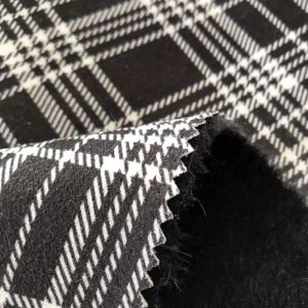
Suede Leather
In the development of synthetic fiber suede products, the raw material selected is microfiber filaments, which are woven into fabrics, and processed through a special dyeing and finishing process to form fine and uniform fluff on the surface of the finished fabric. Microfiber has the advantages of fluffy, elegant, and soft to the touch. The microfiber fabric has excellent drape and softness, and feels comfortable. There are various types of microfiber, suitable for making suede, there are polyester/polyester island type and polyester/brocade orange petal type, the island type fiber is opened by the dissolution method, and the orange petal type fiber is opened by the peeling method. The method of dissolving polyester/polyester sea-island fibers by dissolving method to make them into ultra-fine denier fibers after opening is more reliable.
Therefore, the weft direction uses polyester 16.7tex/36fx371 (island silk) + 7.6tex conventional polyester covering double twist, and the warp direction uses 11.1tex polyester as the raw material for the development of suede products. The raw materials used by some domestic downstream enterprises are polyester sea island yarns purchased from South Korea's Huvis Company. There are 37 islands in the single fiber. After the sea part is dissolved, the single fiber is 0.05De. Has a powdery, soft feel, suede look. In order to ensure the stability of the quality of the finished cloth, domestic manufacturers are required to ensure that the raw materials are first-class products and the same batch number. The fiber-dissolving formula adopts the special high-temperature alkaline water (150℃, pH=13-14 water) process formula that matches the raw materials.
Introduction to the dyeing process of suede fabric produced by polyester microfiber The dyeing of polyester microsuede is much more difficult than ordinary polyester fabrics. Due to the large surface area of the microfiber itself, it has remarkable characteristics in terms of dyeing speed, levelness, reproducibility and color fastness. The microfiber has fine fineness, large surface area, fast dye adsorption and slow diffusion, so the levelness is poor; the light reflection coefficient of microfiber is large, and the amount of dye to be dyed with the same depth of color is 3 higher than that of ordinary fibers. The light fastness, sublimation fastness and abrasion fastness of microfiber fabrics are all lower than those of conventional synthetic fibers. Usually its sublimation fastness is reduced by 1-2 grades